
The arc of history spirals around on itself once again, this time bringing us in parallel with 2006. Time’s sickle may have trimmed away the skinny jeans, terrible eyeliner, and appeal of Russell Brand, but the mid-noughties are back in one potent way, with the return of ID cards.
The idea announced on Friday is that the government plans to deter unauthorised migration by bringing in a new form of digital ID, which all UK residents will have to use to prove their right to work, when being hired. More details will be ironed out after a consultation but at this stage it is fairly light-touch, compared with what is normal in terms of identity requirements in many other European countries and beyond.
It seems fair to say that a government which is not doing well the polls wouldn’t be going near this if it didn’t think there was broad public support. And on the face of it, the latest YouGov survey before the announcement, from June, shows that 57% of people support the idea of introducing national identity cards on an abstract level. Polling by Labour Together, which floated the idea of a ‘BritCard’ earlier this year, found that up to 80% of the public supported it when primed to think about its benefit for a range of specific uses.
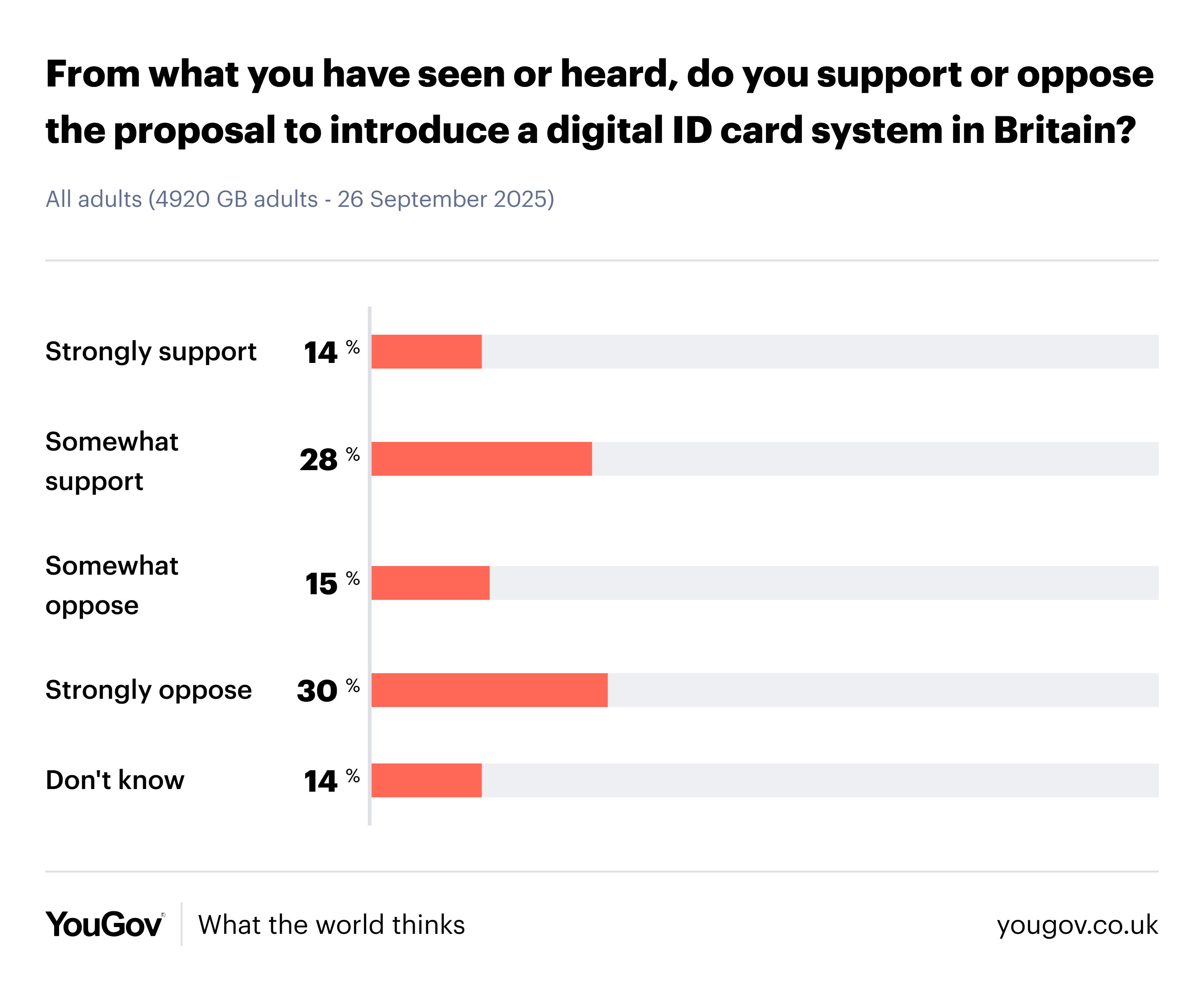
But, even now, that support looks quite a bit more fragile than some of those numbers might suggest. Polling by Big Brother Watch, carried out by YouGov last month, found that only 46% said they supported digital ID when the question was introduced with a lengthy explanation of what type of data it might include and some of its possible uses. YouGov ran a snap poll yesterday in which support had fallen to just 42% while opposition stood at 44%. At the time of writing, a parliamentary petition against ID cards is heading towards two million signatures.
Reluctant though we may be to do so, it’s helpful to cast our minds back to 2006 when, in the wake of September 11 and the London tube bombings, national security had become the buzzword of the times. In the name of improving this, the Labour government legislated to create a full population register – the National Identity Register – and to require people to hold an identity card.
When the idea was first announced, 80% of the public had been in favour, reflecting the fact that it has been attractively billed as a solution to terrorism, crime, football hooliganism, and various other ills making it, in other words, the ‘broad spectrum antibiotic’ of policies (I wrote about this in Bad Data). After civil liberties campaigners launched a highly effective campaign against the plans, arguing that it was instead an open door to making ordinary citizens ‘tagged conscripts of the state,’ support ebbed rapidly away. When the coalition government took over in 2010, the scheme was consigned with some emphasis to the rubbish heap.
It’s important to note that what’s been announced now in 2025 is not a far-reaching system like the 2006 National Identity Register but a comparatively light-touch version in which people will only be required to present digital ID to prove their right to work. But critics are already arguing that it may open the door to more mandatory uses.
The government has been keen to emphasise how much easier it will also make various other interactions with the state, like claiming benefits and free childcare, to be able to prove one’s identity with a quick digital swipe – as opposed to scanning in a bank statement that’s been amateurishly redacted with marker pen. But sceptics may read these assurances as hints as to the other areas of data that will end up linked together in the back end of this system. It will be a tightrope-walk for the government to get through the consultation phase later this year without these civil liberties arguments dominating the debate once again.
The big question is ‘will it work?’ or, perhaps more pressingly, whether the public can be convinced that it is going to work. This will depend on the way it is implemented and how the new rules are enforced. If the goal is to make it harder for people to work illegally in the UK then enforcing a system of universal checks of people’s right to work could well have some impact. But there are areas of the workforce it won’t necessarily affect, such as the 13.5% that is self-employed. Whether it will deter people from coming to the UK unauthorised is very hard to say.
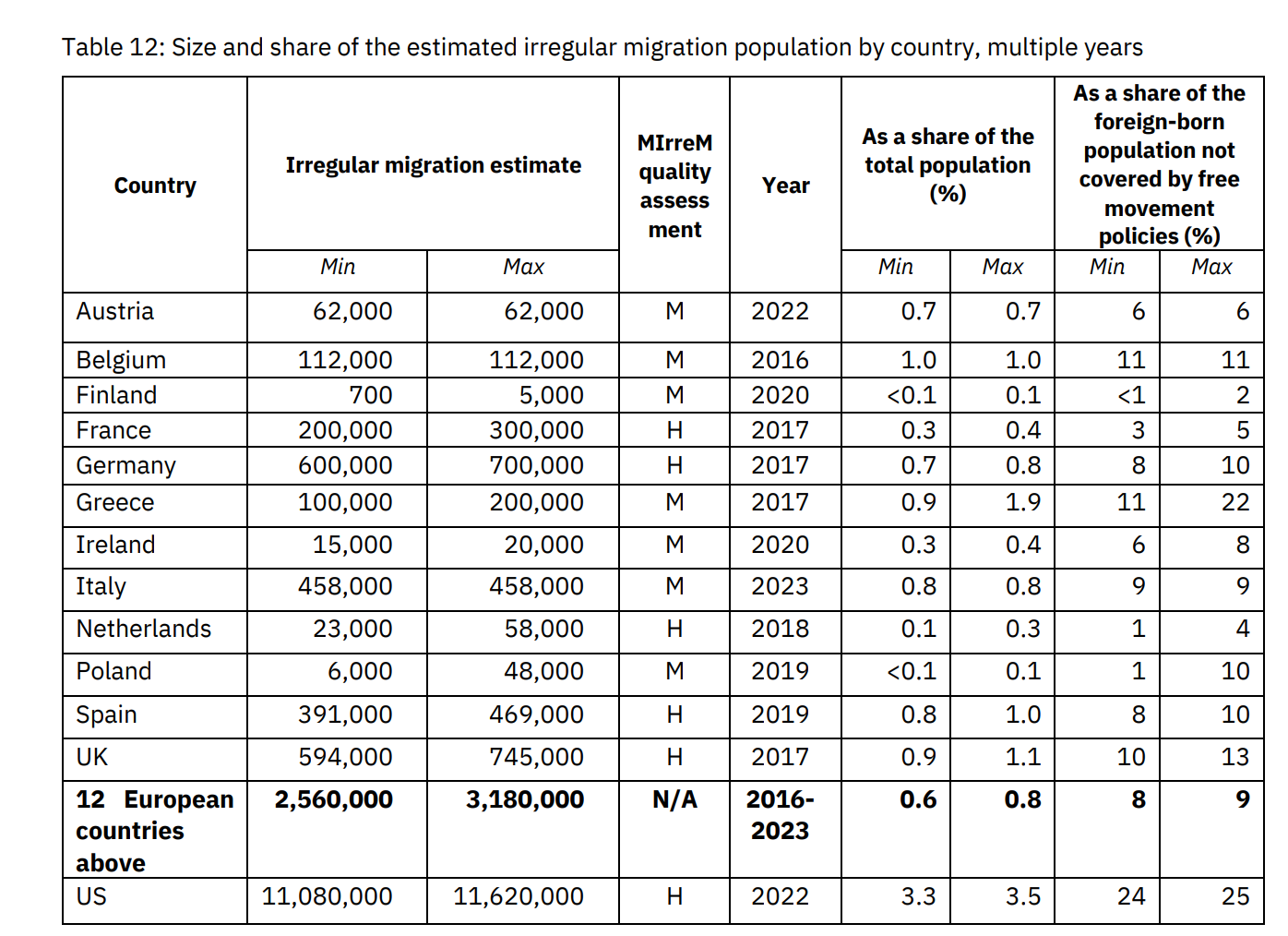
Some, including David Blunkett, architect of the 2006 ID cards scheme, continue to argue that such a system needs to prevent a person from accessing a lot more than salaried employment in the visible economy for it to work as a deterrent. They’re right that going the whole hog and making digital ID compulsory for banking, getting a phone, using the NHS, accessing benefits, and so on would likely make a transformative difference. In the Netherlands, following the enforcement of stricter identity requirements, the unauthorised population shrunk from 194,000 in 1987 to as few as 23,000 people in 2018, but under a far stricter and wider-reaching system than is being proposed in the UK now.
And how do the British really feel about this sort of thing? There’s quite a widely-held impression that we are by nature passionately opposed to governments trying to know too much about our business. This isn’t quite accurate, as we’ve always been compliant with the very intrusive data-gathering process that is done for censuses. During WWII, we had a full population register, which was accepted by the public as necessary and which was only abandoned in 1952 due to its burdensome cost more than anything else. But we do have an antagonistic streak, which is predictably surfacing once again.
The government will need to make a convincing and transparent case for digital ID in the coming months if it is to avoid a re-run of 2006 and all the regrettable decision-making of that time – and no, we don’t need to mention my hair.
You can read much more about our nation’s love-hate relationship with data, including our history with population registers and ID cards in Sum of Us, also available now in e- and audio-book!

Originally published on Substack: https://georginasturge.substack.com/p/id-cards-are-back-this-time-its-digital