
This week I’ve been reading a lot of speculation about what UK Chancellor Rachel Reeves might do after being handed a gloomy new forecast by the Office for Budget Responsibility (OBR) last Friday. This was an internal forecast which hasn’t been shared with the wider nerdery, but economists are expecting that it could blow a hole as big as £30 billion in Reeves’s budget.
This would wipe out the already slim £9.9 billion of ‘headroom’ built into the last budget and which had already been crushed by a downward revision to the forecast in the spring and Labour’s decision not to push through welfare spending cuts.
The problem now, at least according to what’s being rumoured, is that an already rough economic situation for the Chancellor has likely been made a lot worse by the OBR choosing this moment to downgrade its productivity growth forecast.
The OBR, bless its dear heart, has shown a tendency to hang onto optimistic growth forecasts for an unhealthily long time in the past. As this brilliant chart from the Fraser of Allander Institute shows, it clung onto a forecast of 2.0% growth in productivity for about ten years after the last time growth of that level was recorded. In 2016, before it finally downgraded it, the OBR was forecasting 2.0% growth while actual growth was stuck at about 0.3%.
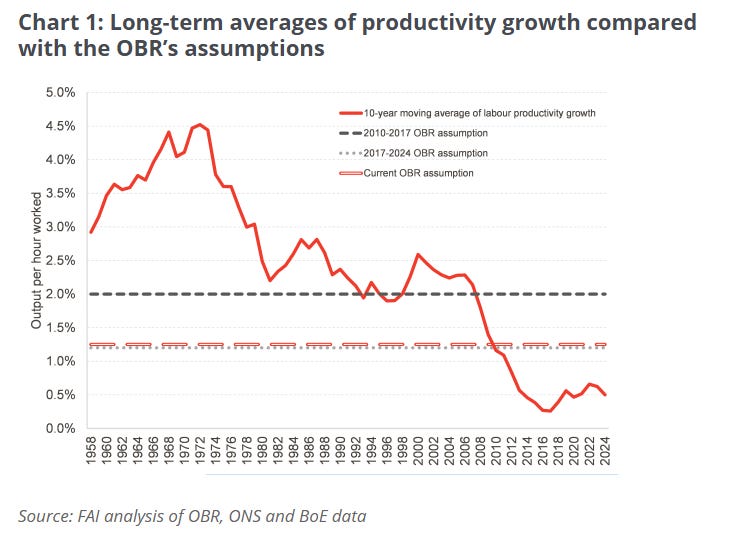
We’re undoubtedly at another such a moment of facing facts now. The forecast has stayed at a stubbornly hopeful 1.2% while actual growth has lingered around 0.5% for over a decade.
It is bad luck for Reeves though that she’s the one that might have to face the music. Looking at that chart with the benefit of hindsight, it’s clear that the OBR had many previous chances to call time on that 1.2% forecast. Particularly given the number of chancellors the UK has cycled through in the past 5 years, it’s just unfortunate that the wheel of fortune has come to a stop on her now.
Or is there something else going on that’s making them doubt the success of Labour’s approach more than that of its predecessors? The OBR doesn’t want to spook the markets unnecessarily, so it seems err on the generous side when rating whether a government’s plans to boost the economy are likely to work. I don’t know the ins and outs of it, but to my eye that bar seems pretty low.
Are they not convinced by GB Energy, the national AI strategy, the recent US tech deal, twelve new towns, or the promise of a third runway at Heathrow? Or are there now too many negative factors out of our hands for policies of this scale to make a dent in our imaginary fiscal future?
It’s black holes on black holes at this point. Does that mean there is no black hole at all…? Physics was never my strong suit.
Treasury staff will be working frantically over the 7 weeks between now and the budget either to push back on a bad growth pronouncement and/or to budget for the new hole in the finances, while keeping up the insistence to the all-powerful markets that Britain is still the next hot thing. As a country we seem to increasingly give off the energy of a strained estate agent whose last hope against financial ruin is to hard sell the merits of a dubious doer-upper.
Luckily for them though, a classic Bad Data style error in counting VAT means they’ve just located £3 billion that they didn’t know was there. I don’t know about you but I find £3 billion down the back of the sofa all the time….
Digital ID is already not looking good
It seems fair to say that the government’s Digital ID proposal, announced just under two weeks ago, has not gone down particularly well. Lead balloons come to mind. Polling by YouGov and More in Common recorded support dropping immediately after the announcement on 26 September from 35% net support earlier in the summer to -14%.
A petition to ‘not introduce ID cards’ seems to have steadied now at 2.8 million signatures, which is almost as many as the highest e-petition to date – ‘Call a general election’ – which reached 3 million as of May this year.
I had a quick look at the data on where signatures have come from and the very large majority are from the UK (always worth checking, since people can sign online from anywhere). As of 7 October, when I downloaded the data, Australia was the most represented foreign locale. With over 3,500 signatures, it’s been revealed as containing more people opposed to the UK having an ID card than in 120 of the UK’s own parliamentary constituencies.
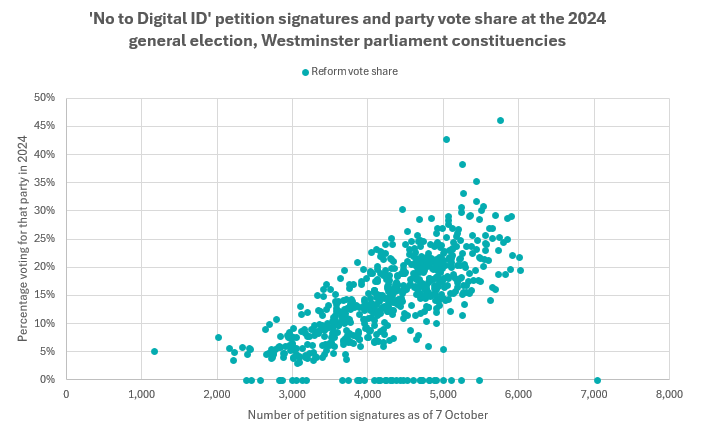
Looking at how people voted at the 2024 general election, it’s not much of a surprise to see a correlation between the share voting for Reform and the number signing this petition. The chart below shows the Reform vote share in each constituency paired against the number signing the petition.
Perhaps more worryingly for Labour, we don’t see much more loyalty there among 2024 voters. Where the Labour share was high (and in most of those seats, Labour won) the view is very mixed. All constituencies have some signatories, and some of those with the highest Labour share – all of them ‘red wall’ seats around Liverpool – have high numbers of signatures.
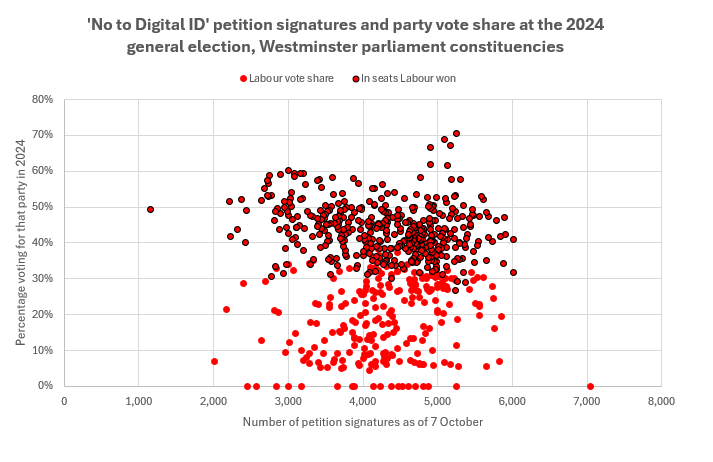
On average in Labour seats, 6% of the electorate has signed this petition, not far below the 7% that have signed it in Reform seats. Disliking digital ID – or perhaps disliking anything announced by Keir Starmer – turns out to be the great unifier.
We will see what comes of this when the promised consultation takes place, at which point I expect we’ll get slightly more detail on the plan itself. And if the government can get the economy going at full gas again, quite a few of its other problems would probably go away – or at least lost some wind from their sails.
And if only those damn numbers would just sit still for a minute.
Originally published on Substack: https://georginasturge.substack.com/p/black-holes-and-reevelations