
Where do our opinions come from? What are they really based on?
It would make sense that we form them by taking in information and thinking it over: reflecting on what we see, feel, hear, read, suspect, and believe. But how often do we really sit down and study the details of a thing in great depth before opining on it? I’ll be the first to say: not often. Who has the time? Or the need?
Actually, it feels more like opinions come to us. We can form them at great speed based on only a cursory appraisal of the facts. Suddenly, they are just there: the opinion is already rising up in us even as we’re taking information in. And in some ways the faster we make up our mind the more intuitive and trustworthy our conviction feels. Being able to form opinions on such limited sight of the facts must make us very intelligent indeed.
Dr Antonio Damasio has another theory. Damasio has spent a lot more time than most people thinking about brains – which, as a leading neuroscientist, you’d expect. One of the most eye-opening moments of his career came when he studied the brains of people who had suffered injury to the part of the pre-frontal cortex responsible for feelings of reward and punishment. These patients could not process emotions like people with healthy brains in the sense that they could not connect emotion with thought.
What was strange and somewhat unexpected about these patients was that they had been left almost totally incapable of making decisions. They had a very hard time deciding what was in their best interest, and even choosing which of two familiar restaurants to go to required a conscious debate of the pros and cons lasting twenty minutes or more. Being injured in the brain had left them with no gut feeling.
Observing these patients, Damasio realised something. Having no emotional cues made it nearly impossible for people to form opinions. While we might expect people to be better at making rational decisions when unclouded by emotion, like a benign Patrick Bateman, the opposite is true. Emotions don’t cloud our judgment, they make judgment possible.
Opinion cannot exist without emotion – this was Damasio’s big realisation. Descartes’ famous statement had been missing something all along: it was not so much ‘I think, therefore I am’ but ‘I feel, therefore I think, therefore I am.’ Psychologists tend to agree, having found in studies that people are better at forming an opinion when their emotions are aroused. The stronger the emotional basis for an opinion, the longer it lasts.
But the beautiful thing about being human though is that we not only feel but think. Emotion comes first but we don’t just react to it instinctively and unconsciously like a cat springing away from perceived danger – we interpret our emotion using other information so as to form opinions and make decisions.
So emotions are essential for having opinions – what does that have to do with anything?
I started to think about this emotion-opinion connection this week in the context of the public debate on migration in the UK. No one can have missed the rising tide of coverage and the escalating language of migration-sceptic voices in recent months. There is clearly a lot of emotion behind these views and the expression of it has become very intense. If there is a debate going on at all, it feels very one-sided.
What I’ve been wondering is why there seems to be so much less emotional intensity coming from the liberal and pro-migration side. Are there far fewer people who hold those views? As I’ll show later on in this piece, there are plenty of people in this camp, and the overall public view on immigration is quite nuanced.
At the same time it’s become increasingly difficult to have polite conversations about migration – whether online or in real life. It’s so uncommon now to hear a liberal or centrist viewpoint on migration that moderates don’t know what to reach for in conversation. Attempts to argue for non-extreme solutions come across as laughably weak when matched against the intensity of how anti-migration views are being expressed.
This matters. Democracy requires polite and respectful discussion of where we disagree. What we have instead is dominance by emotional display.
An emotionally-lopsided debate
The problem, as I see it, is that we the public have the impression that almost all the emotion in the migration debate is being felt by one side.
Specifically, there’s a common belief that the people who oppose immigration are angrier, more upset, feel more personally affected, and are generally more passionate about the issue than people who defend it. I don’t know whether this is the reality – I’d be inclined to think that it’s far from it – but the point is that this is how it looks.
One way in which we ended up here is that imbalanced media coverage and the skew of some social media platforms have likely influenced our perception a great deal. At the same time, the more extreme migration-sceptics have consciously dialled up their rhetoric in quite a short space of time. Social media has turned uglier for everyone in recent years, with a feeling that the gloves have come off and that bareknuckle is just how we fight now.
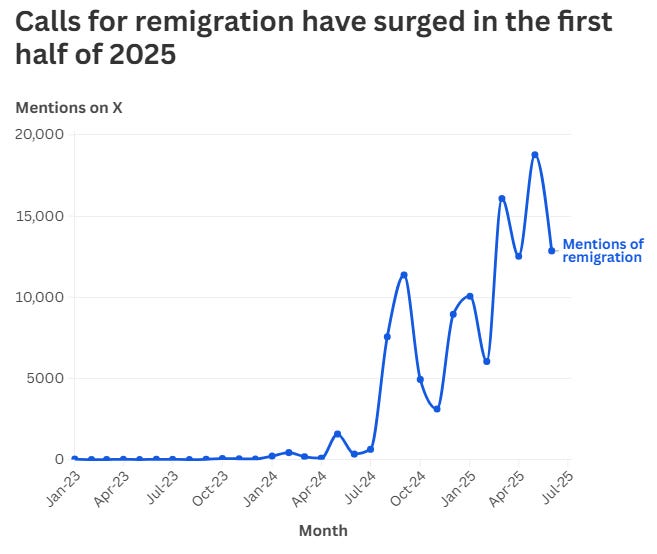
Those with more extreme migration-sceptic views have resigned themselves to some type of violence being inevitable, be that ‘pushing back’ boats in the Channel or even shooting at them, and deporting people who transgress the immigration rules without exception. Coverage of the summer riots and violent scenes at the Unite the Kingdom march have contributed to the common fear that the anti-migration feeling is on the cusp of exploding at any time. The idea that some type of mass violence is inevitable unless we make a national crisis-management effort to avert it is now mainstream.
Although pro-migration and liberal views are out there – and the more extreme ones do pick up traction – I’d be surprised if most people would identify that camp as being the one where the deepest, most powerful feeling lies.
Alright, now let’s look at some representative polling of how the public’s views are split.
Different opinions show up in the polls
Views on migration appear to be changing quite fast, so polling that was done even one or two years ago is not necessarily very accurate now. This in-depth look at public attitudes to immigration published by the Migration Observatory earlier this year is great for understanding past views – but the data might not tell us much now since it’s from 2023.
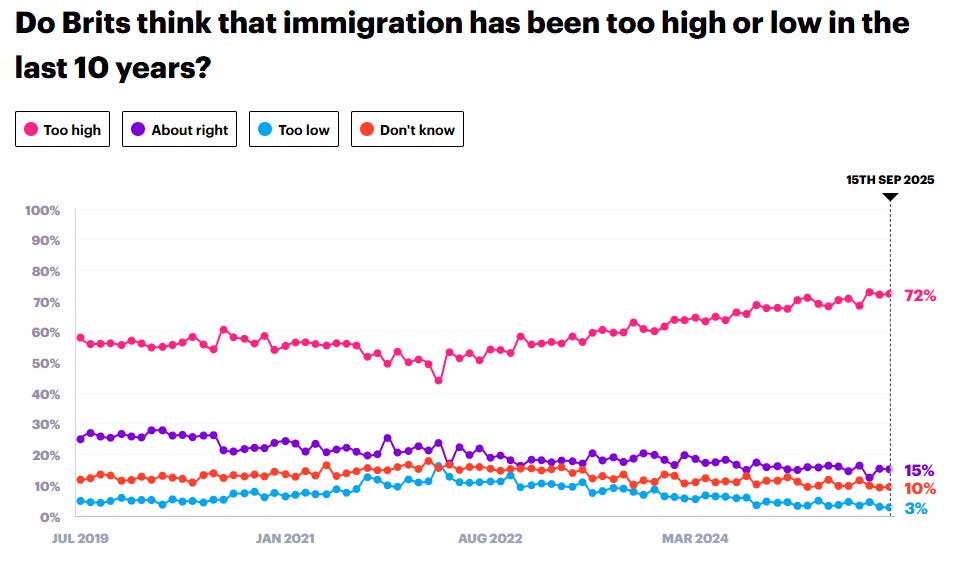
YouGov’s two immigration views trackers give us a more up-to-date picture. Firstly:
And secondly:
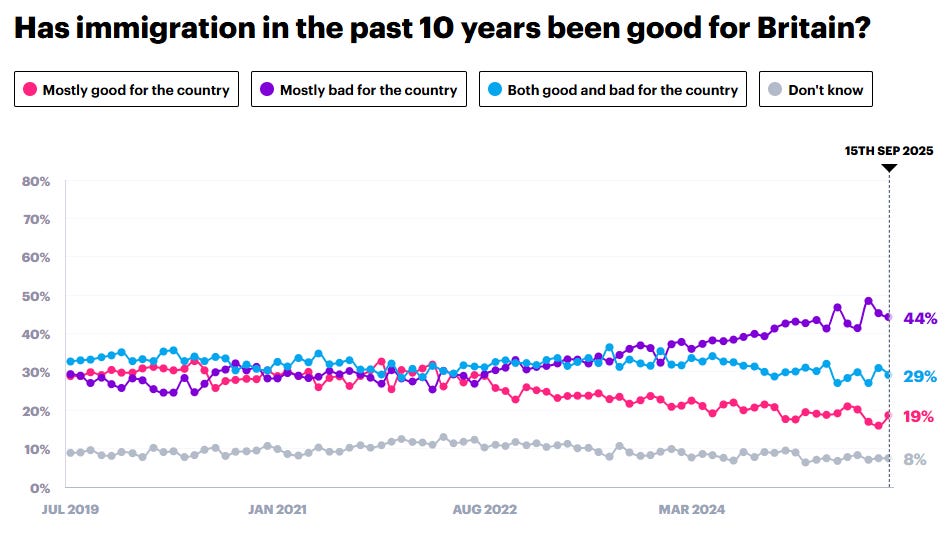
We’re definitely seeing growth in the share that say immigration is too high, although 18% or nearly one-in-five people still think it is about right or too low. More people (44%) think immigration is ‘mostly bad’ for the country than ‘mostly good’, although they are not in the majority overall. Again, around one-in-five think immigration has been ‘mostly good’ and over a quarter believe the impact has been mixed.
YouGov also did some recent ad hoc polling of people’s views about different policy options:

There’s majority support for some of the restrictive options offered here but I think what’s striking is the size of the minority view in quite a few cases:
-
44% don’t support requiring large numbers of migrants to leave
-
32% don’t want to see a large decrease in immigration
-
22% support keeping immigration levels as they are
-
13% support a large increase in immigration.
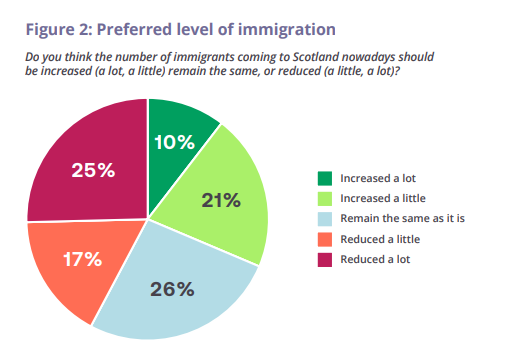
There have been some other interesting snapshot polls recently which also showed that migration-sceptic views are far from universal. Ipsos found that 37% of people thought the share of asylum seekers taken by their local area was ‘about right’ or ‘too little’ compared with 31% saying it was ‘too many.’ British Future did some polling over the summer which showed that 53% of people think the UK is ‘a place where people from different backgrounds get on well together.’ A survey from last year by Migration Policy Scotland found that 31% of Scots favoured an increase in the level of immigration, not a whole lot lower as a share than the 42% wanting a reduction.
Pro-migration and liberal views clearly do exist – and in relatively large proportions on some specific issues. When presented with trade-offs, the share of people saying that they would accept immigration rising even turns into a large majority in quite a few scenarios, for example:
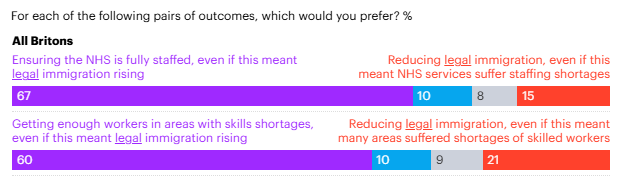
It’s also clear that the type of migration people are primed to think about matters a lot for how people form opinions about what type of policy we should adopt. Views tend to be much more positive when pollsters instruct people to consider only ‘legal’ migration, as opposed to people arriving or staying unauthorised (this type of finding comes up quite consistently in research on views towards different migrant ‘types’).
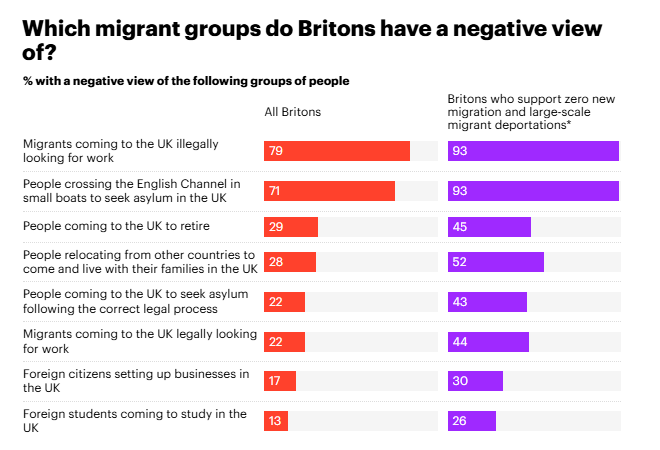
There are different views out there – and let’s not ignore the quite hefty proportion of people who say they don’t know or are undecided on many of these issues – so it feels like there is the need for more balanced conversation on immigration. This is clearly not happening effectively, either in Westminster, on mainstream media channels, or in personal interactions.
But back to those emotions. It seems logical to me that if someone expresses the view, in response to survey, that they don’t want to see the large-scale removal of migrants that they have some emotional attachment to that position. Some of the policy propositions out there are the moment are extreme, and we can very clearly see how strongly the people promoting them feel. But would it not also make sense for people opposing them to feel just as deeply about the issue? Again, it seems to me like we see the anger and frustration as being almost entirely on one side.
I think it would help a lot if we all accepted that when people have strong views either way, they most likely rest on deeply felt emotions. Not everyone has the same way of showing emotion, but don’t assume that it’s not there.
The emotional common ground
It’s said that the way to talk to someone with whom you have very different views is to identify shared values. It’s a technique used in public relations and campaigning: situations in which the person being targeted is by definition someone who hasn’t already been won over but who might be persuaded.
What does finding shared values look like in practice? It might mean identifying that security is something a migration sceptic is worried about and, as a migration liberal, revealing to them that you also have security concerns but that you don’t see migration as the main problem. Other values could be freedom, fairness, or equality: the tactic is to identify the shared value and work with it to understand and persuade. The Migration Policy Centre does a lot of interesting work on this, if you want to know more.
What I think might be an even better approach on the highly-charged subject of immigration would be to look for shared emotions or a way of levelling the emotional playing field.
First though I want to take a quick tangent into the role that facts play in conversations about migration. It’s natural to expect that presenting an opponent with killer facts which prove your own view will change their mind. It doesn’t usually work like this, particularly if the opponent’s current opinion is grounded in emotion. Facts – particularly statistics – are unlikely to directly change someone’s mind, at least not in the middle of a conversation. As I wrote about a couple of weeks ago, people sometimes go into a kind of freeze mode when statistics don’t align with what they thought was true. And just from experience we all know that there is nothing more irritating than someone whose general view we fundamentally disagree dropping an ‘I think you’ll find’ factoid into an argument. You can keep your fun fact.
The other problem with using fact-bombs as weaponry in debate is that statistics can be used to make any point you want. Sure, if you want policy to work as intended, you need to use them wisely. But if the goal is to bolster a particular argument then I guarantee that you can – at the very least – find some scrap of data to make your case. In the heat of a debate, a statistic can always be deflected either with another statistic or just a single, anecdotal case to the contrary.
Someone who has declared that people crossing on small boats should be immediately sent back isn’t likely to be swayed from that position with a chart on migrants’ overall fiscal contributions. Complaints about the nightly cost of asylum hotels are likely to fall on the deaf ears of someone who believes we should be doing much more to help refugees.
Remember: emotion comes first in opinion formation, then comes the appraisal of facts. In neuroscientist Antonio Damasio’s words, “we are not thinking machines. We are feeling machines that think.”

It’s important that facts are out there for people who want to find them. That’s easier said than done in a lot of countries but in the UK we have a very extensive suite of published official statistics, quite a lot of transparency in government, and a culture that encourages fact-finding and holding to account. We shouldn’t take that for granted.
I want to suggest instead that people actually put down what they think are the facts for a moment and focus on the emotions at the root of their views. Might there be some overlap in the emotional states being experienced by migration sceptics and liberals? There’s sure to be common ground.
Fear is probably the biggest emotion being felt in both instances. Anger, and the feeling of having been wronged will be there in both cases too, as will feelings of love and compassion towards those we care about and have the instinct to protect.
Understanding the emotion behind another’s opinion allows us to see their vulnerability. This might seem like a hard thing to achieve, since it forces us to overcome our feelings of frustration, disgust and even hatred towards those we most disagree with. But the stronger the opinion, the more vulnerability is probably at the root. And neither side has a monopoly on feeling vulnerable – it’s not something a person can help, although it may be overcome.
People might have their facts wrong – and we might find that frustratingly obvious. But unless we meet them on common emotional ground, we have no hope of persuading each other to see things differently. That’s what a healthy conversation is: some differences of opinion, some agreements. What’s going on in the UK at the moment is the opposite of that: a grim, angry and cruel shouting match.
What I would say to anyone trying to express their views in a clear and persuasive way – and particularly to people with views that are currently receiving less coverage – is this:
-
Tell us why it bothers or hurts you so much to hear the views you’re disagreeing with or trying to change.
-
Let us see and understand the emotions at the root of your own convictions.
Instead of judging an opponent as factually mistaken, deluded, callous or not sufficiently invested, consider that the only reason they have an opinion at all is because they have an emotional reaction connected with this issue.
I realise it sounds a bit floaty to find ‘shared emotional common ground.’ If nothing else, I hope you’ll take from this that if someone has an opinion – even if it’s the polar opposite of yours – it means they feel affected by this too and that they care.
After that we can get to establishing and agreeing on some facts.
Originally published on Substack: https://georginasturge.substack.com/p/a-monopoly-on-emotion