“This is crazy, man! This is outrageous!”
Those were the words of Ian Lavery MP speaking last week in the confused final minutes of a five-hour debate in the House of Commons on the Universal Credit and Personal Independence Payment Bill. Over the course of that painful afternoon, the sixteen-page bill had disintegrated almost entirely as the government withdrew several key clauses mid-debate. Members ultimately voted on a two-page bill containing none of the significant, money-saving restrictions to disability benefits in the original. It was unprecedented. In MP Helen Whately’s words, “describing it as chaos now feels like an understatement.”
The original substance of Labour’s welfare proposals had been aimed at cutting spending on disability and health-related benefits by making some people no longer eligible for them and reducing the amount some other claimants received. This was with the idea of saving close to £5 billion by 2029/30, with long-run savings of up to £11 billion per year.
Ministers’ focus had been drawn to the disability caseload – and specifically the Personal Independence Payment (PIP) – as a potential area for making savings because the number of claimants had increased in recent years, in the government’s words, “much faster than prevalence.” The message was that there were people claiming PIP who didn’t necessarily need it.
A situation where “one in 10 people of working age are now claiming a sickness or disability benefit,” with spending set to rise to four times the budget of the police by 2029/30 was not, they argued, sustainable. The rebels in Parliament insisted otherwise.
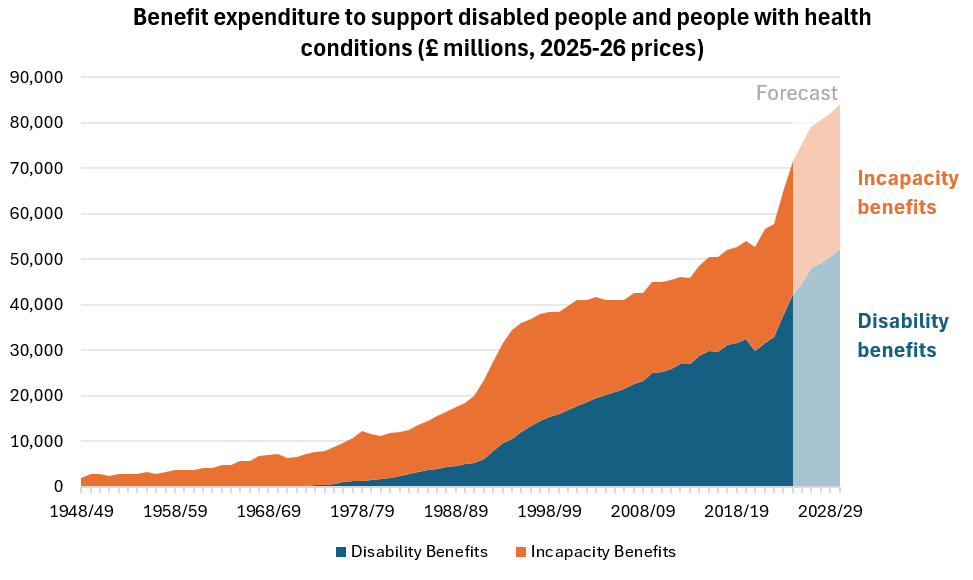
What it comes down to is a debate over what it means to qualify as disabled and that the cut-off point for being ‘in’ or ‘out’ is always going to be somewhat artificial.
This is something I wrote about in Bad Data and I want to return to that again here.
Defining who is and isn’t disabled
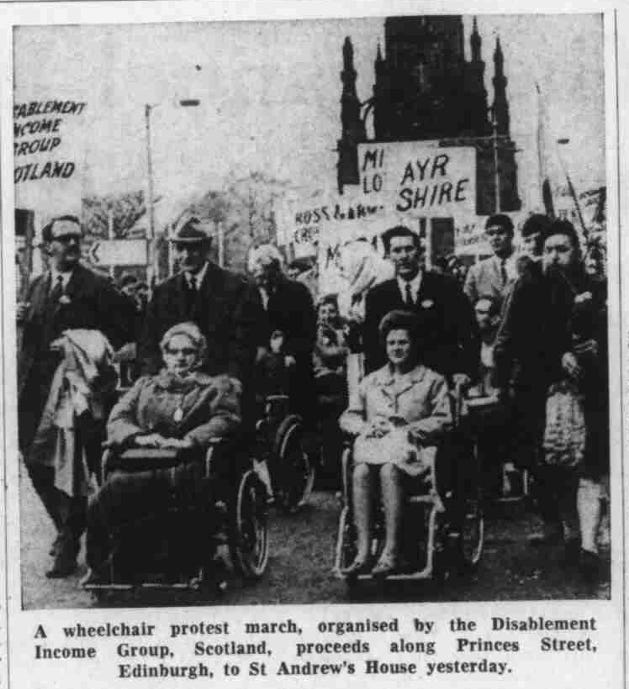
In Bad Data, I told the story of Megan de Boisson and Berit Moore, two women from Godalming who started a campaign for non-contributory disability benefits in 1965. Convening as the Disablement Income Group (DIG), the ‘DIG housewives’ campaigned for any kind of statutory support for people with life-limiting and incurable conditions, which only existed at the time for men who had suffered a workplace accident or injury in the war. Many of the DIG campaigners had been paralysed after surviving polio; du Boisson and Moore both had multiple sclerosis.
A DIG chapter was also established in Scotland and the clipping below shows one of their protest marches in Edinburgh in 1968. Campaigners from across Great Britain travelled to Westminster to deliver petitions and lobby MPs. On at least one occasion, a group of students organised themselves to stand ready to carry DIG members up the stairs into the Palace of Westminster because it had no wheelchair access at the time.
DIG’s legacy was to secure the two original non-contributory disability benefits: Attendance Allowance and Mobility Allowance. It took around 20 years, until the end of the 1980s, before the number of people claiming disability allowance reached the 1.5 million or so that had been expected, based on prevalence.
In the 1990s, these benefits were absorbed into the new Disability Living Allowance (DLA) and the scope was expanded beyond profound physical impairments to include less severely limiting disabilities as well as mental illnesses and conditions. Crucially, the process for determining eligibility shifted into an individual’s own assessment of their capabilities. By the 2010s, the caseload had gone up to 5 million people.
We’ve been here before
Ironically, the benefit that the government tried to trim last week – Personal Independence Payments (PIP) – was introduced in 2013, as a replacement to DLA, with the purpose of slimming down a caseload that was considered to have got out of hand. Ministers at the time were concerned that more than half of claimants were being deemed eligible on the basis of self-assessment alone. The implication was that, if left to assess need for themselves, people would exaggerate their difficulties in order to ensure that they qualified.
When PIP came in, all existing DLA claimants had to reapply, which caused outrage at the time on behalf of people who had permanent disabilities like limb-loss or paralysis, as well as those for whom the stress of reassessment exacerbated their condition.
And although the number of claimants dipped slightly in 2013/14, the overall disability caseload went back to where it had been under DLA and continued to rise. A huge effort to weed out ‘undeserving’ claimants ultimately made little difference. Of the 1.1 million people who were denied PIP between 2013 and 2022 and challenged the decision, 84% ended up having their benefit reinstated at tribunal.
In this recent effort to reduce PIP spending, the attention has been on mental health disorders, with arguments made that sufferers of these conditions could, in some cases, achieve self-sufficiency through work if reasonable adjustments were made. And when we look at the proportion of claims where the main disabling condition was a psychiatric disorder, that has been steadily rising over time. This could be the result of many factors, one of which is more sensitive recognition of mental health conditions in the medical profession and society at large.
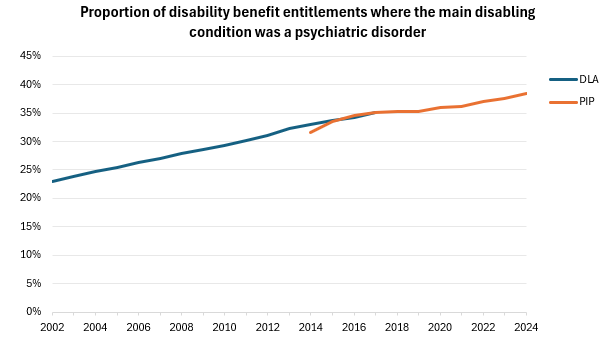
What this all demonstrates is the difficulty of setting thresholds when the state of being disadvantaged ‘enough’ to warrant support is fuzzily-defined.
Who should decide on cut-off points?
Disability benefits are there to make sure people with physical or mental health problems don’t end up destitute or in danger. But who should determine whether someone is at risk because of their condition? MPs? Doctors and scientists? Carers and social services professionals? Or the claimants themselves?
The current system relies partly on medical diagnosis and partly on individuals’ own report of whether or not they can carry out certain essential activities unaided. In practice this means answering questions about everyday tasks, such as washing, preparing food, going to the toilet, dressing, reading and writing, and communicating with others. Some assessment questions are answered with ‘yes’, ‘no’ or ‘sometimes’ and others with a broader scale. Activities are assigned a certain number of points, based on how much it is deemed significant to a person’s welfare that they cannot perform that task.
Labour’s proposals, which were scrapped last week, involved re-grading some of these activities. For example, needing help to wash their hair would score a person two points; needing help to wash between the shoulders and the waist would be worth four. Claimants would have had to score at least one four-pointer to qualify for the daily living component of the benefit – two ‘twos’ would not have achieved the same.
Points and categories are always going to be somewhat crude and artificial, there is no getting past that. Any system which relies on self-assessment to distribute a rationed benefit needs judging criteria. And in isolation, yes, they can look absurd and even cruel.
But in fact this type of points-based system is essential to the modern welfare state because it is meant to be much fairer than only compensating people for chronic physical conditions on medical diagnosis alone, as in the time of the DIG housewives. Slowly, over decades, the system has evolved to recognise a much broader spectrum of disadvantage. Two governments now have tried to reverse that evolution – both found that it would not go.
Originally published on Substack: https://georginasturge.substack.com/p/who-counts-as-disabled