If anyone ever claims economic forecasting in an exact science, consign them in your mind to the bin. Trying to anticipate how much an economy will grow, how much productivity will change, and what the labour market will look like in several years’ time is impossible to do with complete accuracy. Economists can be confident about some hard spending commitments coming down the pipeline, like debt repayment and pensions, but most other variables are fundamentally unknown.
And yet for all the uncertainty – which economists themselves take pains to acknowledge – the twice-yearly economic forecast produced by the UK’s Office for Budget Responsibility (OBR) has come to dominate the decision-making of politicians and determine the fate of governments.
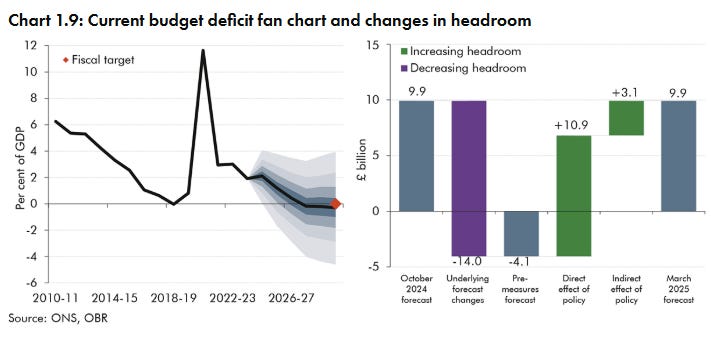
There has been a lot of commentary recently on Chancellor Rachel Reeves’s decision to cut government spending on disability benefits in response to the OBR revising its 2029/30 economic forecast in March 2025. The key figure was a change in the forecast of government spending in that year from a surplus of £9.9 billion to a deficit of £4.1 billion. These welfare cuts were then rejected by Labour’s own MPs, wiping out all of the Chancellor’s spending ‘headroom.’
The optics were horrible, the press cruel – and now a group of 40 Labour MPs have publicly called for the Chancellor to “stop treating single-point [OBR] estimates as gospel.” Others have called for the OBR’s forecasting cycle to be reduced to once rather than twice a year, to wean us off short-termism.
And they have a point. OBR forecasts are not exact predictions. As the chart below shows, the £4.1 billion budget deficit ‘forecast’ for 2029/30 is just the mid-point of an enormous spray of possible realities. A difference of a few billion here or there is nothing in the context of all that uncertainty. Yet cuts to benefits made in service to a shimmering fiscal target have real and immediate impact on people’s lives.
The OBR is not at fault. It is an independent body wonkishly devoted to the task of constructing plausible economic models, and is approved of in the international scene and even admired. Although it is reliant on the quality of data produced by government departments and the ONS which, as we know, is not always up to scratch.
The problem is that an obsession with precise, single-point figures has, for years now, led politicians to make drastic tax and spending decisions on the basis of what seems like scientific justification but which is in fact – and I mean this without criticism to the modellers – fiction.
When the OBR was first established in 2010 to take over forecasting from the Treasury, LSE’s Professor Timothy Besley warned that,
“The problem with putting too much weight on the short- and medium-term forecasting is that this organisation is bound to fail if that is the way in which we judge it, because we know that the success of short-term economic forecasting is extremely limited, and for good reasons; it is just not a science, if you want to call it a science, or an art, that is fully developed to a point where we can rely wholly.”
Economists at the time were more worried about how it would look for the OBR when its forecasts were inevitably proven wrong, with Oxford Professor Simon Wren-Lewis foreseeing “the dangers to the credibility of the organisation of focusing on the short-term forecasting role are very large because forecasts are always wrong.”
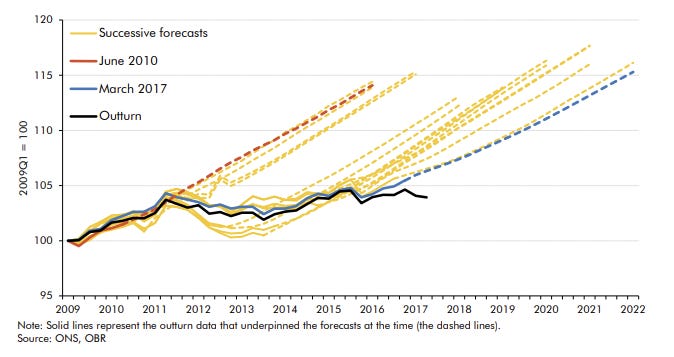
As the OBR’s classic ‘hairbrush’ chart of its repeatedly over-optimistic productivity forecasts shows, the ‘always wrong’ pronouncement turned out to be one thing they could predict with certainty.
The much greater danger though is not that faith has been lost in economic forecasting but that the faith has become too desperate and too deep. Numbers which should not be treated as precise in the first place are being treated as immovable objects – until they do move, and the cycle starts again.
There is something unnerving about the ability to switch abruptly from belief in one precise economic prediction to another. It reminds me of the government in Nineteen Eighty-Four which, on deciding that we are not at war with Eurasia but Eastasia, goes to great pains to scrub away everything that might suggest another reality ever exists: we have always been at war with Eastasia; Eurasia has always been our ally.
The same mental process is required to turn on a pin towards the conviction that the OBR’s forecast of a £9.9 billion surplus in 2029/30 was wrong and that £4.1 billion is the true figure – we just didn’t know it yet. But what devotees of single, specific numbers need to realise is that the £4.1 billion is ‘wrong’ too or, in the OBR’s own words has “virtually no chance of being correct.” It too will be revised, and a huge technocratic operation will start up to adjust to another new reality.
In terms of alternative to the status quo, it definitely seems like a good idea to reduce the frequency of economic forecasting and/or move away from single-point estimates. But it feels a bit unfair to deny these numbers to more restrained users, just become some people get hooked.
What I wonder is whether there could there be a more intuitive and looser way of using economic evidence to govern. Evidence shows that what the public want in a Chancellor is sound judgment, an understanding of economics and decisiveness – but they do not want ‘ruthlessness’. When it comes to the all-important markets, what they favour is rock-steadiness and something like a positive mindset. International markets have been repeatedly spooked from a decade now of British unpredictability and perverse decision-making. The International Monetary Fund (IMF) has indicated it would support a move to annual rather than twice-yearly forecasting to try and calm the knee-jerking down for longer periods.
It’s worth noting that Labour is still somewhat tarnished from its dealings with the IMF in the 1970s. In 1976, it sought a $3.9 billion bailout from the IMF after Treasury figures indicated it would run out of money otherwise under the pressure of high inflation and a currency crisis. It was later concluded that the figures had been more apocalyptic than was justified – and indeed the loan was only half used and repaid in record time.
The bigger fallout then was within British politics. The Labour party looked like it was running around screaming with a firehose, before it turned on itself in its exhaustion, allowing Thatcher’s rebranded Conservatives to claim public confidence. Britain’s economic problems are not as immediately serious as in the 1970s – but politicians should take heed of setting themselves up for similar traps.
Originally published on Substack: https://georginasturge.substack.com/p/why-do-we-rely-on-forecasts-which