
Not for want of trying, the British state has done a fairly poor job of collecting data about transgender people.
Before the 2021/22 census first asked a question on gender identity in England and Wales and transgender identification in Scotland, only one estimate of the transgender population had ever previously been made, which had put the total at a rather paltry 6,800 people across the UK in 2009. The census didn’t fully plug the data gap either, despite suggesting that as many as 282,000 transgender people called Great Britain home.
It’s now widely agreed that the England and Wales question on gender identity was botched, given that it led to the implausible finding that 1 in every 87 residents of Newham in East London or roughly one person per street was transgender. This was after the question had been tested extensively on transgender respondents and, unfortunately, not as well on people who didn’t understand English well and mistakenly opted into that category.
More recent efforts to collect data on the long-term outcomes of people who were referred to the NHS’s Gender Identity Development Service (GIDS) as children have also come up empty-handed. It’s for this reason that, as of 20 March 2026, the government is bringing into force a statutory order which will unseal the NHS records of former GIDS patients (the clinic closed in 2024) for the purposes of a data linkage project. This will allow the Department for Health and Care to look retrospectively at the healthcare journey these individuals have been on since attending GIDS.
The reason the Secretary of State has resorted to the big guns now is that previous efforts to persuade NHS providers to submit the information needed for this data linkage study had got nowhere. More specifically, seven adult gender dysphoria clinics (GDCs) in England had already been instructed to hand over patient data for the purpose of the study in 2022. Even after extensive cajoling, only one had complied.
The data linkage study had been commissioned as part of the Cass Review into gender identity services. Researchers at the University of York were supposed to use data from GIDS, hospital wards, outpatient clinics, emergency departments and adult GDCs in order to track the 9,000 or so patients seen by GIDS while it was in operation, looking at outcomes such as mental and physical health, uptake of cross-sex hormones and surgery, and whether they had de-transitioned. To date there is still a very scanty scientific evidence base on what good or harm medical interventions for gender dysphoric children do.
The York researchers had spent time listening to the concerns of the GDCs and talking to their service users. Among the latter, most were supportive of data linkage when they had the purpose of the study explained, and some expressed surprise that this type of data wasn’t collected as a matter of routine.
But things turned political. As reported by the York researchers, GDC staff refused to share data on the grounds the “the unintended outcome of the study is likely to be a high-profile national report that will be misinterpreted, misrepresented or actively used to harm patients and disrupt the work of practitioners across the gender dysphoria pathway” and that the study “may suffer from interference by NHS England, the Cass Review Team and Government ministers whose interests do not align with those of providers and users of gender identity services” (from Appendix 4 of the Cass Final Report).
These were strong allegations, revealing an existential distrust of government and its motivations. Rather than continue trying to negotiate or pacify, the Government has now clearly had enough. In announcing the new legislation, the Health Secretary expressed his “clear expectation that all relevant organisations will now provide the data required to complete this study.”
In theory, anyone obstructing an authorised person from accessing the data could be found in contempt of court which, at the extreme, can be punishable with two years in prison.
As fate would have it, another case has been occurring at the same time of the Government getting fed up with people not providing the ‘right’ data and reaching instead for data linkage.
It concerns the Family Resources Survey (FRS), a long-running household survey which may not sound exciting but which is the entire basis for our official estimates of poverty rates in the UK. The FRS interviews around 20,000 people per year, asking them in extensive detail about all sources of household income, one area of which is welfare benefits.
In 2021, the think tank Resolution Foundation pointed out that the sum of all the benefits income people reported to the FRS was around £40 billion short of what the Department for Work and Pensions (DWP) itself declared to have spent, in 2016/17. More recent analysis by the BBC found a similar gap in 2023. This likely means that, for whatever reason, there is systematic under-reporting of benefits income and that the child poverty headcount could be over-estimated by as much as 500,000.
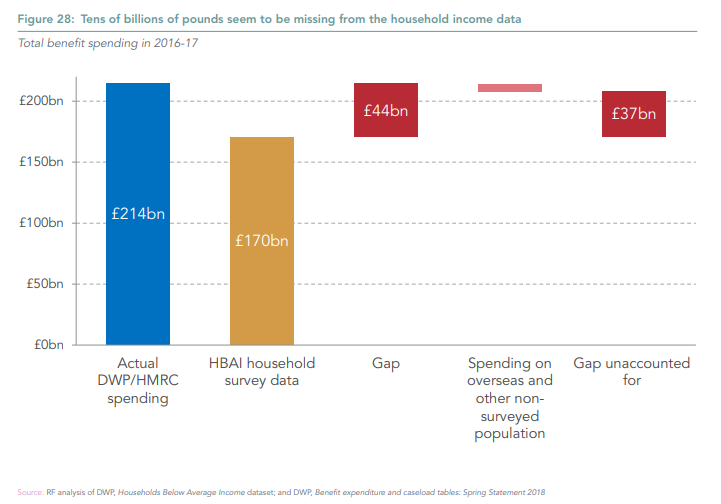
In response to this, the DWP, which runs the survey, has now started linking people’s responses with its own administrative records of what benefits it has given them – the idea being to ‘correct’ respondent misreporting and fill in any blanks.
When the first statistics produced using this new method are published on 26 March, it’s expected that they’ll have a large shrinking effect on the number and proportion of people officially classed as living in poverty (below 60% of median income).
But the data linkage exercise could have other consequences. It’s worth noting that it hasn’t needed any new powers to do this. In the DWP’s own words,
“The implementation of the General Data Protection Regulation (GDPR) in June 2018, provided ‘public task’ (GDPR Article 6(1)(e)) as an alternative to consent as the lawful basis for linking.”
The phrase ‘alternative to consent’ doesn’t have great optics, it has to be said. People spend hours answering the Family Resources Survey. It can be incredibly tedious and fiddly to complete, and by Resolution Foundation’s own inference the under-reporting of benefits data is likely due to confusion and fatigue with the complexity of the benefits system itself. To fact-check those responses against other records without a person’s explicit consent feels underhand at the very least. People might also rightly question why they should give up all that time to answer questions the DWP already knows the answer to.
In theory, the DWP can also access a great deal more records on income which people pay tax on, via data linkage with HMRC. Whether it was a smart move, in terms of the look of the thing, to focus on the benefit claimants first remains to be seen.
These recent instances of data linkage are not one-offs, or at least they won’t seem like that as time goes on. They’re part of wider trend and ambition of the UK statistical services to make more extensive use of the administrative data on people that’s collected all across the state. The 2018 GDPR was a turning point and data linkage is now the name of the game.
Not long ago, surveys and the decennial census were the only way the state knew anything about what was going on in people’s work and family lives. Even now, the Labour Force Survey is still the primary means for governments to know about employment and unemployment and how many people work in each industry and where.
But response rates to social surveys have been declining. Lack of representativeness in a survey can also be an issue even when response is good, as witnessed when hundreds of thousands of EU migrants slipped through the net of the International Passenger Survey in the mid-2000s, causing an underestimate of net migration which has never fully been resolved.
The idea is to eventually replace reliance on surveys with administrative data. The Office for National Statistics (ONS) may have backed down from its position two years ago of wanting to imminently replace the census with admin-based statistics but we’re still at a rubicon of sorts where data linkage is starting to replace the need for people to actively participate in giving up their data. This is a fundamental change for the relationship between people and the state. Do we want this level of disconnection, where the state knows a lot of things about us that we don’t remember consciously providing?
When the ONS recently proposed that the census could be replaced with administrative data (an ambition now pushed beyond 2031, when we will have another national tally) one of its suggestions was to source ethnicity data from diversity monitoring forms collected from patients of NHS Talking Therapies. These are forms people have filled out when referring themselves for counselling. Diversity monitoring can already feel gratuitous, and suspecting it will be linked and used for unknown analytical purposes could really take the wind out of our sails in terms of willingness to answer them.
There’s also a bit of a misconception – or perhaps just an overlooked complication – in thinking that using admin data removes the need for self-reporting or, indeed, consent. Quite a lot of admin data actually is self-reported and a great deal of it relies on people obediently submitting things honestly and on time. The penalties for not doing so are usually mild, if there are any at all.
This brings us back to the start and to the NHS’s transgender data linkage study. Even if adult NHS records can be obtained for most people who used GIDS services during their childhood or teenage years, these could be incomplete. The NHS is notorious – although less so now than in the past – for records not being transferred when people switch GP and for paperwork from hospital and clinic referrals not making it back to a person’s central file. And that’s before we get into the near-total lack of connection between the NHS and private health services, through which some transgender people seek hormone treatment to bypass NHS waiting lists.
If we want to know the answer to specific policy questions, often what’s best is a specifically-designed study which, say, follows people over time and tracks what happens to those who do and don’t receive a certain intervention. Funnily enough, this was the idea behind the recently paused Pathways puberty blockers trial, which was supposed to randomly assign hormone-suppressing treatment to a cohort of children and monitor their outcomes against a similar group which didn’t receive it.
The trial was broadly supported by transgender activists and the same gender clinics who had viewed the data linkage study as a trojan horse to “harm patients and disrupt the work of practitioners.” In other works, it was one method of evidence-gathering which had at least moderate buy-in from all sides. It has now been scrapped, and it’s hardly surprising that transgender people feel betrayed by this whole episode.

There’s a real risk that this kind of heavy-handedness when it comes to data collection could damage public trust. In Sum of Us, I chronicled many instances of people refusing to hand over information because trust was gone – from Suffragettes literally going on the run rather than fill out the 1911 census, to residents of multi-cultural Haringey being very reluctant to participate in the first tests of collecting ethnicity data in the 1970s out of suspicion as to how the data might be used.
Being able to withhold data is surely a basic civil right, not to mention a hallmark of liberal democracy. Like it or not, collecting and using data on people is a negotiation between the data collectors and the subjects of it – that applies even if we’re talking about administrative records.
With public trust already low, it’s more important than ever for governments and statistical authorities to explain and to win us over before rummaging around even if, legally speaking, they don’t have to. Taking a statutory crowbar to people’s NHS records and opening them by force might well result in better data and better-informed policy. But in other ways it might be a step in an undesirable direction.
Originally published on Substack: https://georginasturge.substack.com/p/the-silent-creep-of-data-linkage