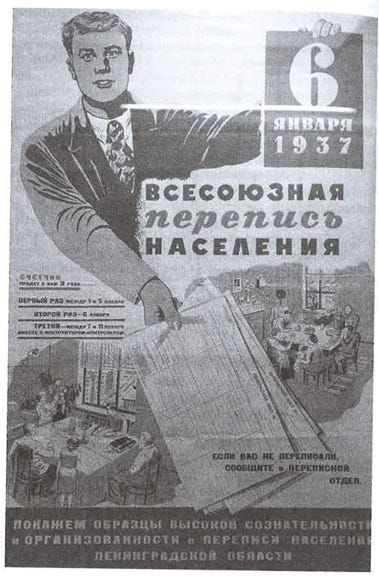
The 1937 census of the Soviet Union took place in deep mid-winter, when a good many families were gathered together for the start of Russian Orthodox Christmas. But there were two men that year who weren’t feeling much of the festive spirit. Olimpy Kvitkin was the director of the 1937 Census; his colleague Ivan Kaval was head of the Central Office of Statistics – both were nervous.
The census had been preceded by weeks of propaganda about how important it was for families to fill it out as generously as they could manage. For years, Stalin had been boasting of how life under socialism has lifted the birth rate, increasing population growth faster than in the West. Posters and pamphlets advertising the census told of the schools and hospitals which would be built once the true scale of the population boom had been officially recorded.
Once the results came in, however, Kvitkin and Kaval knew already that they were marked men. The Soviet population totalled eight million people fewer than had been projected, silencing all talk of a lusty birth rate under socialism. Kaval tried to tactfully explain that Kulak purges in Ukraine and Kursk might not have helped grow the population, and Kvitkin offered a recount outside of the holiday season. When the numbers didn’t improve, both bureaucrats were arrested and shot.[1]
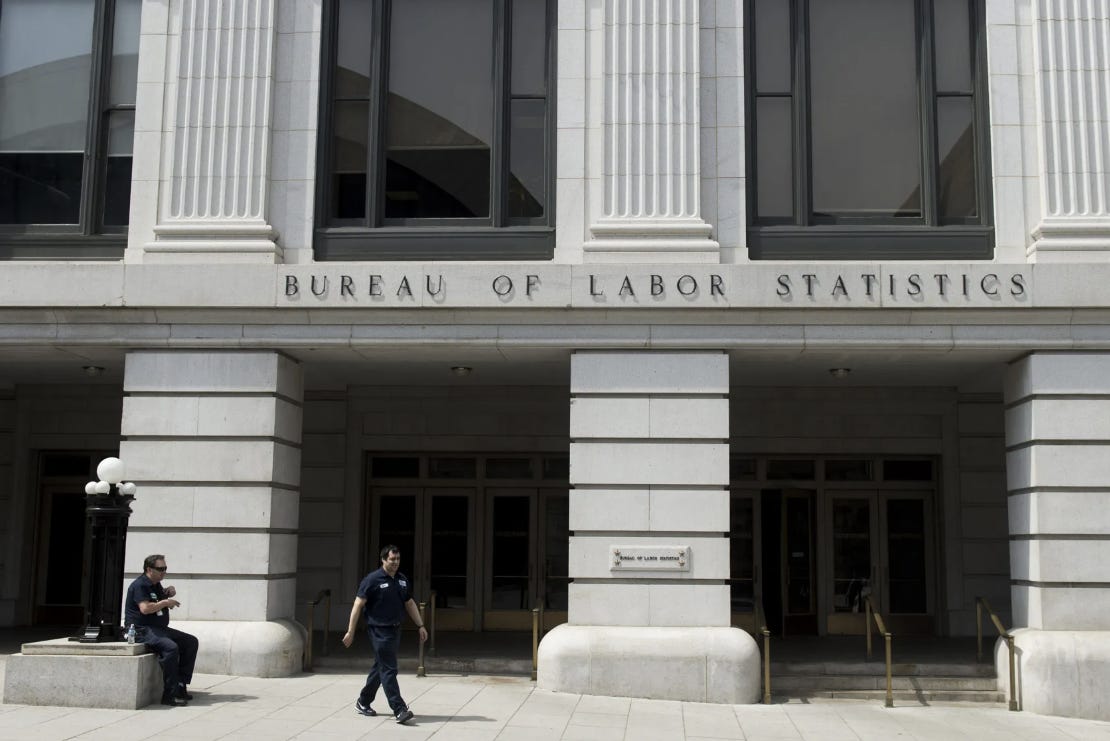
This episode is one of the most extreme cases from history of statisticians being blamed when a politician takes exception to the numbers they produce. Such barbarity is now thankfully in the past, although events last week in Washington DC couldn’t help but bring it to mind.
Following the publication of new employment statistics which involved a major downward revision for some recent months, Trump took the drastic step of firing head of the US Bureau of Labor Statistics (BLS), Erika McEntarfer, whom he accused of “faking” the disappointing figures. McEntarfer wasn’t being punished for counting so badly that major revisions were needed – she was accused of being a saboteur who had published “rigged” and “phony” numbers to help the president’s political opponents.
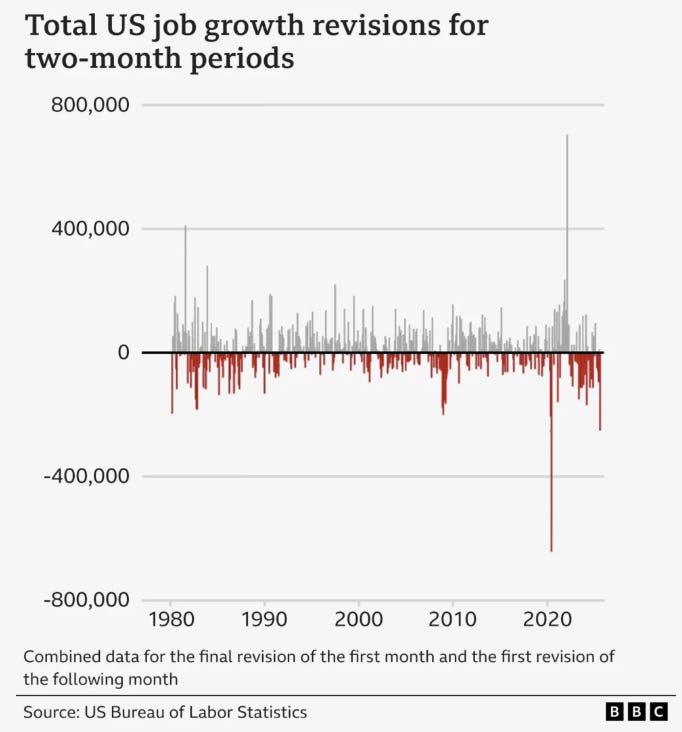
It’s really quite bonkers when you see it written down. Even more so when you consider that revisions are such a normal part of publishing statistics. Yes, these revisions in this case were large – the number of employments in May and June 2025 was revised downwards by a combined 258,000 jobs – but within the scope of normal variation. Looking at the back-series, there hasn’t been a single two-month period in history where the original estimate wasn’t revised.
Revisions or delays: a politician’s dilemma
The BLS’s estimates of jobs created come from the Current Employment Statistics survey, a monthly questionnaire sent to a sample of businesses who are asked to report on positions created, among many other things like salaries paid. Ideally, these would be completed and returned by businesses very quickly, but the reality is that they often get filed late. In many cases – 57% at the last count – the questionnaire isn’t returned at all.
A problem for statisticians is that they have politicians and economists from the Federal Reserve breathing down their necks asking to see the monthly results as quickly as possible, because they need to be factored into other processes like calculating inflation.
When only a fraction of businesses respond in a timely way, statisticians have to fill in the blanks, based on patterns they’ve seen before. What might have gone wrong in this case was, ironically, that small businesses had been more cautious about expansion than in the past as they waited for the impact of Trump’s new tariff regime. Because smaller businesses take longer to respond to surveys, the full effect of this response wasn’t picked up until after the initial estimates – which had assumed business-as-usual for this type of company – had been published.
Timely, accurate, and affordable to produce: statistics can only be two of these three things at once.
Because politicians tend to prioritise the ‘affordable’ part, revisions are inevitable in many areas of statistics. Rather than wait longer for numbers or compensate businesses for filling in surveys, we end up with situations like we had earlier this year, where the UK’s Office for National Statistics had to revise its wage growth figures because just one business didn’t submit its data in time.
A phony war
If Trump’s administration were serious about improving the accuracy of employment statistics, the right approach would have been not to fire the Director of the BLS but to increase its resources. Perhaps it’s a possibility – and if more funding for labour statistics does appear this would be one good thing to come out of an otherwise sorry episode.
The opposite scenario seems more likely though, given that Trump’s new appointment for head of the BLS, EJ Antoni, is an advocate for a small-state economy who called for taking “a chainsaw to the BLS.” Echoing the President’s language, he has dismissed its figures in the past as “phoney-baloney.” Now we’re hearing that Antoni may abolish the monthly jobs report altogether. That could be a good idea, if it means more accurate but less frequent publications. But government departments, the Fed, and a host of others are still going to expect – and need – those more timely figures – what does Antoni propose to do about the ongoing and entirely normal problem of bias in those?
Another chapter of the Kvitkin-Kaval saga is worth reflecting on too. After the two statisticians were executed as scapegoats for the Soviet census ‘undercount’, contrary to some people’s expectations, the numbers didn’t improve. The census ended up being annulled for the reason that it had been sabotaged by enemies of the state. A new head of the Central Office of Statistics was appointed in May 1937.
But when eight million people didn’t suddenly emerge from the population statistics, the new director was scapegoated too. He was arrested and executed for being a counter-revolutionary saboteur not even a year into the job. His protestations that he had not even been around for the census count fell on deaf ears. In total, only a quarter of statisticians from that era survived the purges. The only conspiracy they were guilty of was trying to maintain some reflection of reality in the figures they produced.
Accusations of sabotage create paranoia. There’s a lot of pressure on the one who is brought in to clean house after a ‘saboteur’ is ousted because they have to be seen to make big changes even if there was nothing phony going on at all. The statistics industry really needs to stay free from all of this, or the already weak grip that we have on what’s accurate and true becomes even harder to maintain.
Footnote:
[1] This story comes from Thorvaldsen (2019/2017) Censuses and Census Takers: A Global History. Routledge.
Thanks to everyone who’s read and subscribed to this Substack so far! I’m taking a short break now from writing and will be back in September.
Originally published on Substack: https://georginasturge.substack.com/p/revising-statistics-the-real-crime